
Stories of Sakitawak
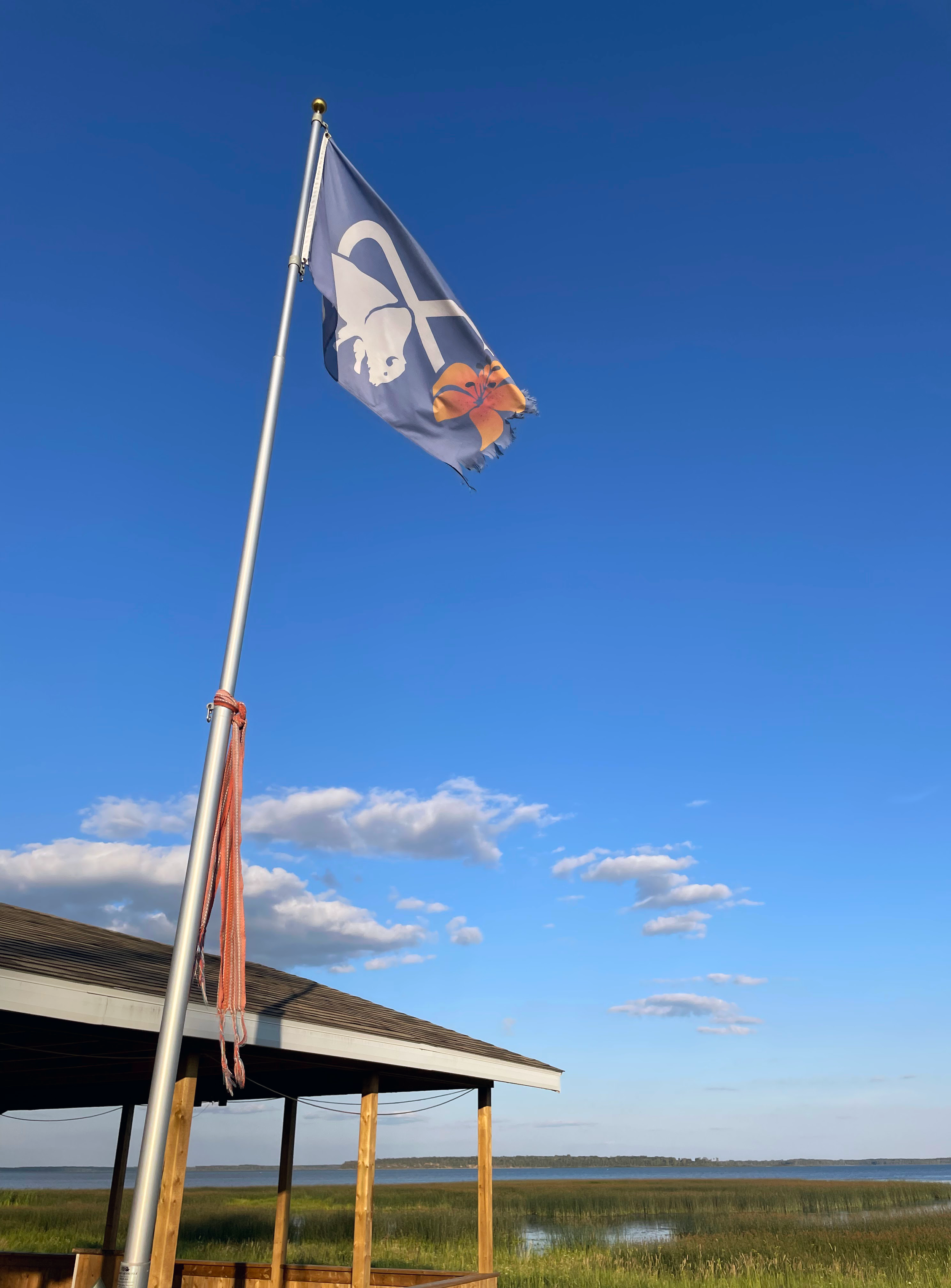
A Métis flag blows in the wind in Île-à-la-Crosse on August 2nd, 2024. Photo courtesy of Aqsa Hussain.
In 2024, the Métis community of Sakitawak, or Île-à-la-Crosse, of Northern Saskatchewan decided they wanted to conduct a Traditional Land Use study (TLU). Through the Sakitawak Development Corporation and A La Baie Métis Local 21, they contracted the University of Saskatchewan Department of History’s Co-Lab Centre for Community-Engaged Research to facilitate this TLU.
The community is nearing its 250th anniversary in 2026 as the second oldest community in Saskatchewan and they wanted to map and document the important cultural heritage of their relationships with the land. In multiple trips to Sakitawak, we sat in office board rooms, kitchen tables, and picnic benches at campsites, to listen and learn from extraordinary elders and their histories about using the lands of Northern Saskatchewan and Alberta.
Researchers Aqsa Hussain and Jessica Jack were there to hear and record these histories. Aqsa Hussain is a recent graduate with a BA in History and settler as a child of immigrants from Pakistan. Jessica Jack is a medical anthropologist who was born and raised in a white settler family in Saskatchewan and is pursuing a second master's degree in History.
After the honour of hearing the stories of the elders who shared with us, we as researchers turned those stories into a collection of custom maps and interview transcripts and returned them to the community for their use for years to come. But as individuals, we witnessed the joy of elders reminiscing on past times, and the sorrows of seeing how time has made powerful changes. There was laughter and tears, moments where everyone was talking at once, and times where we all sat still in the busy silence of reflection and reminiscing.
This article explores the depth of histories that were shared with us by those generous community members. Like many such studies, the Sakitawak TLU of 2024 demonstrates the deeply interconnected nature of Métis history, relationships with land, place, and people, and the ongoing legacy of those who have walked, snowshoed, paddled, and sledded these lands from time immemorial into the present day. However, the maps and transcripts we produced could only capture a fraction of what we were told. We wanted to touch on the other subjects and themes that emerged during this project, ones that might not be reflected in the official study materials. While no article can cover everything that we were told, we want to honour the complexities of the histories and people involved in this important project. What follows are some of the stories of Sakitawak.
History of Sakitawak
Sakitawak (Île-à-la-Crosse) is one of the oldest villages in Saskatchewan and its name is derived from Cree for “the place where the rivers meet.” At almost 250 years old, it is a space where Indigenous and European settlers came together to create a rich Métis society. Due to its valuable geography as an intersection of three prominent rivers, many Indigenous peoples in Northern Saskatchewan have roots in Sakitawak.
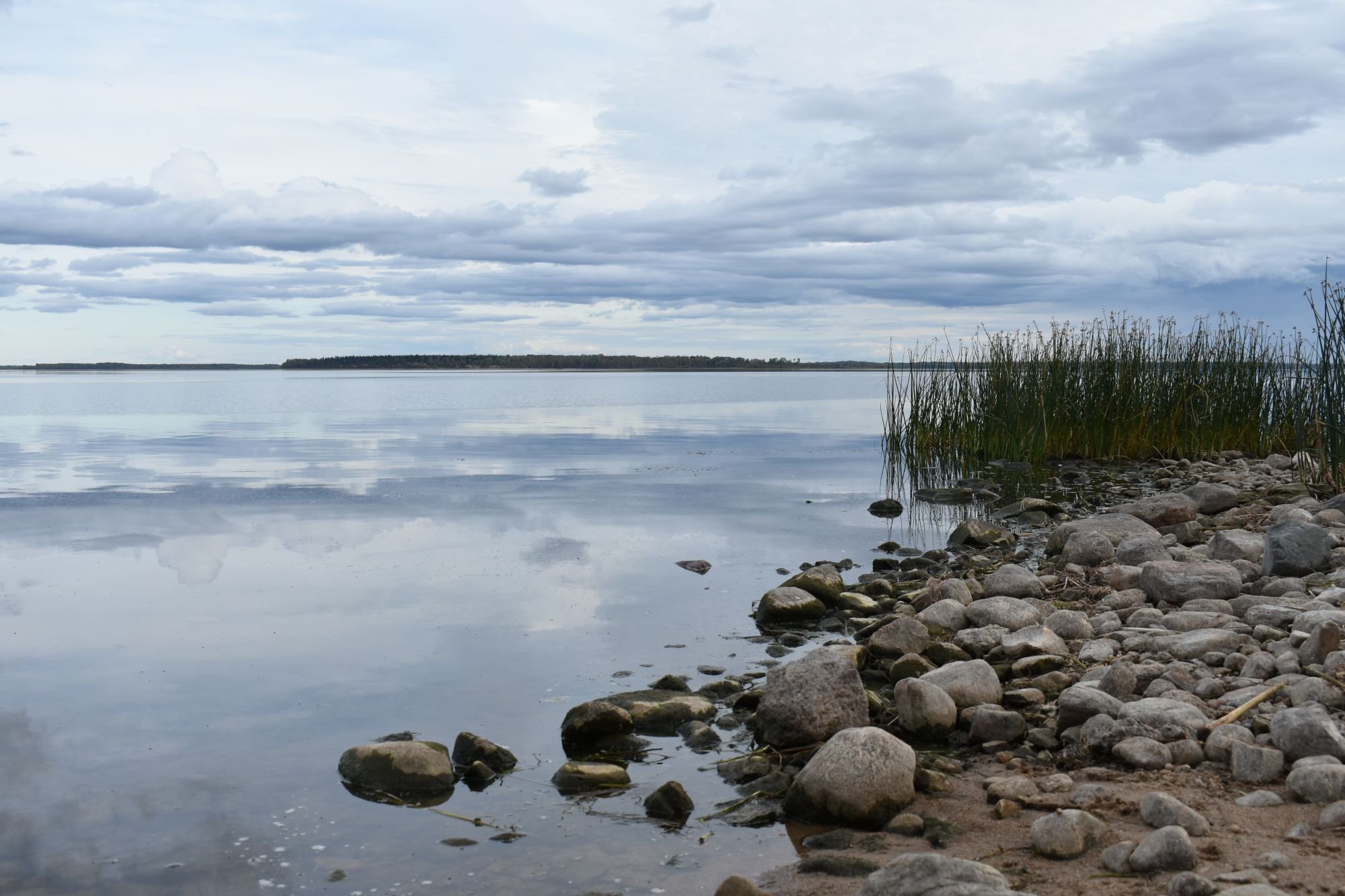
Rocks on the side of Lac Île-à-la-Crosse in September 2024. Photo courtesy of Aqsa Hussain.
The land holds historical significance. Before settlers arrived, it was an important meeting ground for Cree and Dene peoples to come together and later became an essential space for fur trading posts with both competing Hudson’s Bay and Northwest Trading companies having a significant presence in the area.
And as was the experience of many Indigenous people across Canada, the community also experienced cultural genocide through a number of colonial institutions, including the residential school system. After many years of fighting for justice and denied settlements, in March 2025 residential school survivors reached a $27 million agreement with the federal government.
The Métis community of Sakitawak is strong and prospering and has been working tirelessly for their land rights. Unlike treaty members, Métis people have to go the extra step to show their traditional land use to be included in crucial duty to consult negotiations that often come from natural resource companies or industries practicing extraction of those lands. TLUs are stepping stones for securing land rights. Next, we explain how we conducted the study to support these important goals.
TLU Methods
We had a two-part interviewing process: talking and mapping, which we ended up doing with 12 people who shared their stories with us.
We would start with wide-ranging questions about who they were and about their individual and family history of land use. We wanted to follow their stories and hear about what they learned, who they learned it from, and how traditional land use shaped or was shaped by their ways of living.
Once the conversation shifted to stories of where land use happened, we would bring out the maps. We had 21 National Topographic System maps, ranging from Green Lake to the south to Lake Athabasca in the north, and spanning west to east between the Alberta and Manitoba borders. We attached these maps to coroplast boards to make them easier to transport, then we laid clear sheets of vinyl over each map. As community members talked about their land use, they would mark these activities on those vinyl sheets.
After these interviews, we analyzed the results. Jessica would transcribe the recorded interview audio, and Aqsa would do map transcription, double-checking that the marks on the maps matched the interview transcript and adding any marks that were missed.
With the transcripts, we entered all the map points into our mapping software, ArcGIS Pro. We made an individual map for each person interviewed, as well as maps showing all interview data for each activity type (all fishing, all hunting, all trapping, etc.). Ultimately, we produced more than twenty maps for this project. But as previously mentioned, these maps only tell a fraction of the whole story.
Changes To The Land – Aqsa Hussain
The most eye-opening part of this TLU for me had to be the oral histories that I had the opportunity to hear, and the knowledge and reflection gained from them.
One of the many gifts of listening to those older than you is to hear stories about how times have changed. Change, a concept we can all relate to as we age and witness the way the world transforms in front of us; the generational change, land changes and technological changes are transformations I’ve witnessed in my own life too.
I think back to the many community members we spoke to who emphasized the importance of speaking one’s native tongue and the sadness felt about younger generations speaking less and less of it. It’s a generational change that I see myself as part of the South Asian diaspora, where I have become more comfortable speaking English than my own mother tongue.
Rather than focusing on the sadness of this common transition between multilingual speakers, the participants we interviewed were making amazing stridesto keep their language alive, and our project was able to be a part of that. The importance of language was stressed to us, leading to the creation of a map that used traditional place names Métis and First Nations people have long used, with Michif, Cree and Dene origins. In the course of our interviews, participants made it clear that these kinds of language vitalization efforts were incredibly meaningful for community members.
Community members Ted Ratt and Vince Ahenakew are working hard to keep the Michif language alive. Vince helped us with translation, and Ted shared many Michif words with us in our interview. It is an inspiring reminder to value the various languages you speak, take pride and find resilience in speaking your mother tongue.
In another example of change over the last several decades, technology has become an increasingly valuable benchmark to understand and analyze change over time. Linear thinking would have us believe that change is always progress and therefore good, but speaking to those who lived in different times demonstrates what we’ve lost.
When asked if the land had changed over time, every participant answered yes. Some said it bluntly, as if the change is so obvious as to be matter of fact. Others answered passionately, either concerned by the level of change or in heartfelt advocacy about the impacts of that change. Many cited climate change and forest fires, and some discussed how new technologies played a role in these events and questioned their pros and cons.
Technology helped a lot of land users do their work more efficiently. Motorboats help you cross the water faster than it would take to paddle and there are boats specially made to collect wild rice. Snowmobiles helped make travelling in those long winters much smoother.
Peter Durocher, a community member who is an important part of the conservation effort for the Woodland Caribou, helping to create an Indigenous Protected and Conserved Area in the N-14 fur block in Northern Saskatchewan, spoke on how these technologies were beneficial but also had their downsides.
“The biggest thing that I see—technology is good, but it’s also bad. Because there’s a lake over here, we call it Senyk Lake. It’s probably about maybe 70 kilometres by snowmobile. When the people used to take off from here to go there, used to take 2 or 3 days. Nowadays you would go there and back, one day. And then all these loud skidoos and with all the pollution and everything, all these animals scatter. It’s a bit harder to them, eh.”
Animals scattering is not beneficial for trappers or hunters, an issue that also applies to concerns about wild rice. Wild rice was not native to the lakes and was introduced to the community in the 70s, becoming another valuable source of income. But this introduction was not without its own impacts, as Ted discussed with us.
“I got nothing to do with wild rice. I don't believe in that too much. Our land used to be beautiful with the water lilies and everything. Moose were more plentiful, I think, in them days when there was no wild rice, eh?” Ted said.
For others, wild rice was a positive introduction. “We were the first ones in the community to buy a wild rice boat,” said Felix Merasty, who later shared his 1985 family’s wild rice lease document with us. Wild rice harvesting has become another important type of land use since its planting.
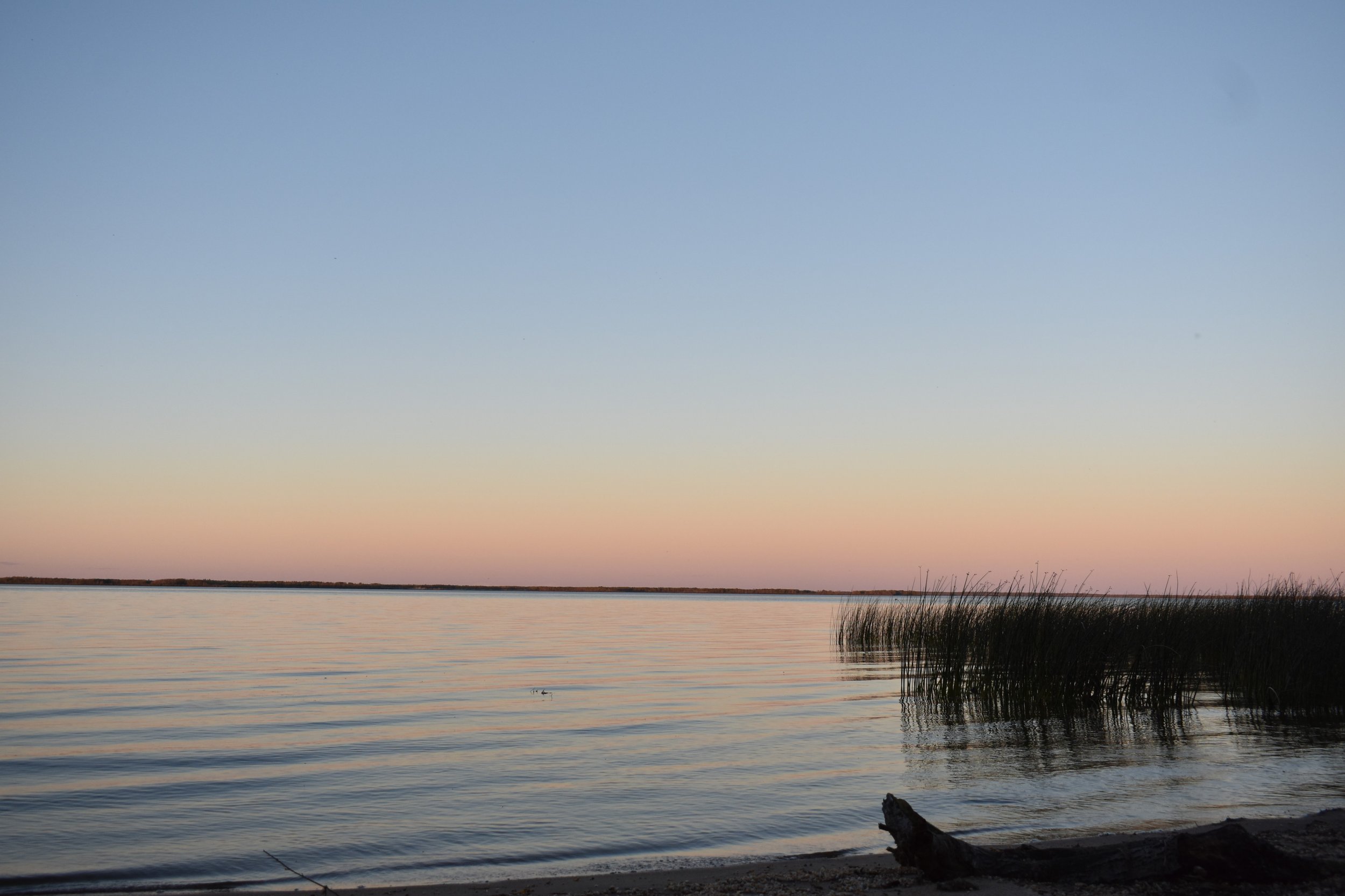
Sunset on the horizon of Lac Île-à-la-Crosse in September 2024. Photo courtesy of Aqsa Hussain.
The advancement of technology has moved fast and the introduction of screens in our workplaces and homes has created a sort of dependency that can also range into addiction for many. It seems like an overdone cliché to blame issues on kids being on their phones at this point, but it was a point that many participants mentioned. George Malboeuf spoke to this when he said:
“The difficulty now is because people spend so much time looking at a screen or playing with their cell phones, or addicted to some, something else… the kids forget how to survive because they were never taught."
George and his wife Norma help teach camps to kids in their community on how to live off the land and emphasize the importance of learning these skills.
“If technology is to die now, the people that live off the land are the only ones that are going to survive. Other people won’t survive. Completely disintegrated. Because if you can’t have a trap in your hand or a snare on your hand, you won’t survive. If you have a net in your stuff that you have to survive, you’ll survive,” George continued.
George was not alone in this opinion, as Peter also told us “Technology is awesome, but technology is not going to feed you.”
Land use and survival are undeniably intertwined and the recurrent mentions of how detrimental depending on technology is points to a larger division between those living off the land and those of us who have to rely on others—a reality that became especially apparent during the COVID-19 pandemic.
“A lot of Elders say that hard times are coming and the land, the land will always feed you,” Peter shared with us. “And when I think about COVID, when the COVID happened here and we were running out of supplies and stuff… for us, it was easy here. Like, I felt so bad for people in the cities, like in big cities like New York and stuff like that. Here we can—fish is right there, right? Animals, ducks, and, they’re all here, so we could—that’s what I teach to our young people nowadays…if the power goes off, you guys are going to starve because you won’t be able to microwave anything.”
The histories I heard resonated with me on both a personal and professional level. Hearing community experiences with change, whether in the Michif language, in technology, or in responses to COVID-19, really showed me how diverse the importance of land use is to the community of Sakitawak and how valuable TLUs are. While these were some of my takeaways, they were not the only conclusions to come from this project.
Daily Life With The Land – Jessica Jack
While I heard the same oral histories as Aqsa, my focus was slightly different because it was filtered through my own experiences. One core aspect of traditional land use that I noticed strongly is day-to-day living, the key components of resource gathering and survival. This kind of land use faced new challenges as the waged economy crept into Northern Saskatchewan in the latter half of the 20th century. We heard how community members took on paid jobs to feed their families, working in jobs like conservation officers, firefighters, commercial fishermen, and truckers.
For some, waged employment helped them afford modern tools to use the land, such as snowmobiles, fishing gear, and traps. For others, working jobs left them with little time or energy to do land use activities. Participants often fondly remembered their family members doing waged work in balance with self-sufficient land use. William Caisse said, “My dad had little odd jobs in the summertime of his carpentry, made good of it. We lived off the land, we had ducks, whatever we want, chickens, rabbits, moose.”
As time moved on, many did not see that same balance in contemporary life; William continued, “We don’t see any of that now close to our community.” This was a sentiment we often heard from the participants, as waged employment and the cost of living in the North can make it difficult to continue with land use activities. While many still engage at some level, such as a community-wide moose hunt in the fall, the demands of modern life can complicate being on the land in the way their families had in the past.
George, another prominent land user, pointed to another complex reason why Métis land use is so important and yet changing over time – shifting relationships with knowledge from Elders.
“Growing up in this community, you get to enjoy the surroundings. There’s always something to do. There was never a shortage of what you could do here because if you enjoyed hunting, you’re out in the land all the time. If you enjoyed harvesting, you were out in the land all the time. So there’s always something to do here. The sad part about it is that a lot of the knowledge that we have as Elders is not passed on to the young people. […] There’s a lot of knowledge in our community if only people would approach the Elders.”
There are a lot of intersecting reasons for the lack of knowledge transmission between generations. One is changing priorities over time. Many who we interviewed spoke about outside influences that compete for time and attention from young people, including technology, the appeal of city life and larger job markets, and shifting social lives. Some younger community members spend their time and effort on these activities instead, eschewing the priorities of their Elders. But to call this change an intentional choice would be misleading.
When given the chance, it seems many younger people find joy and fulfilment in traditional land use. George and his wife Norma often volunteer to teach traditional cultural skills at the local school and share that young people get excited about traditional land use activities if given the opportunity, such as outings to learn how to skin muskrats or catching, dressing, and eating local fish. But they are not always given these opportunities because of broader social forces, including the ongoing effects of colonialism in Northern Saskatchewan.
For the heavily Métis population of Sakitawak, the impact of colonialism on knowledge transmission, and land use activities more broadly, cannot be ignored. Residential schools, such as the nearby Beauval Indian Residential School, deprived children of opportunities to learn from Elders, keeping them from continuing traditional ways of living on the land. The Sixties Scoop actively took children out of their cultural contexts and connections, robbing them of knowing their culture and learning how to use the land. Broken generational connections between families and the trauma associated with colonialism have added difficulty to passing along traditional cultural values and practices.
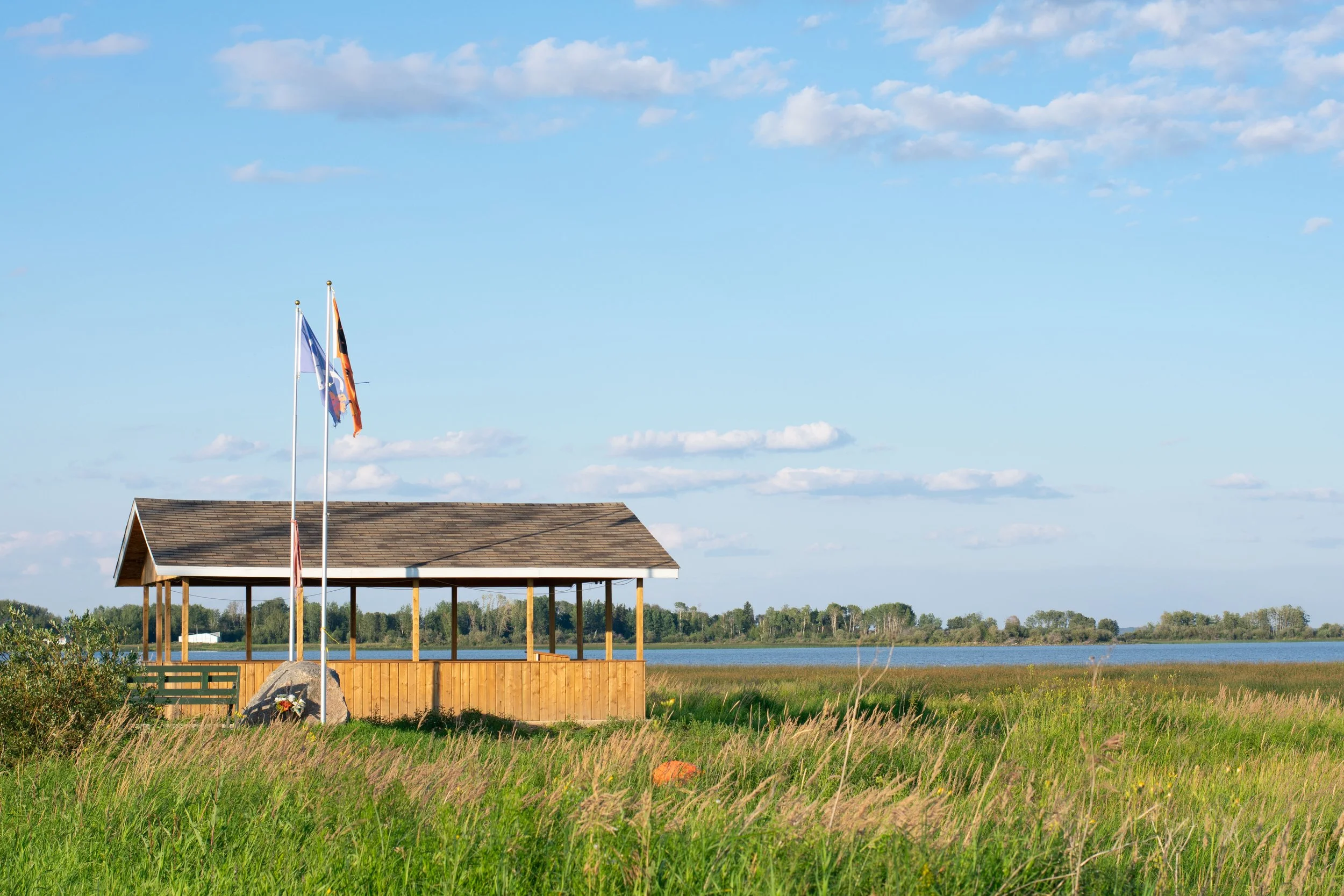
Wooden picnic shelter stands in front of Lac Île-à-la-Crosse serving as a memorial to residential school survivors alongside an Every Child Matters and Métis flags on September 23, 2024. Photo courtesy of Aqsa Hussain.
Other colonial impacts to land use activities include restrictions and changes to land access, like the creation of borders separating the provinces, the reserve system, the parks systems, and restricting land use through industry or government actions. Peter told us about the impact of the development of the Primrose Lake (sometimes called Cold Lake) Air Weapons Range.
“My grandfather [...] was in the bombing range [Primrose Lake Air Weapons Range] in 1952 when they went in. There was [...] a few families from Île-à-la-Crosse that were there. There were families from Buffalo [Narrows], from Beauval, Canoe Lake, and [...] government just went there and said, okay, you know what? You've got 30 days to get out of here. You know, these guys been here for years. They had cabins built, they had boats there, everything. They had to leave everything. They just took everything. Whatever they can load on, and they took off from there. And then they put the border off. And we never had no access till that new agreement with PLEDCO [Primrose Lake Economic Development Corporation], 25 years ago. Since then, now we have access, now I can actually, as a citizen of Île-à-la-Crosse, I can actually apply for a permit to hunting there now.”
All of these restrictions and more have separated people from traditional land use areas and from community connections that had existed and evolved since time immemorial. Yet despite these problems and barriers, many people in the community told us about their dedication to continuing the important land uses that are central to their way of life.
Some are teaching traditional land use skills in classes in the community, showing children the delight of making traps or preparing and eating the fish they just caught. Others are involved in large-scale research projects that will showcase the vast amount of land use and knowledge that still exists among community members. And yet others are continuing to use the land, maintaining those direct connections with Métis ways of knowing and doing that have been passed down for generations and are a major part of the cultural heritage of the community and the area. And I will always be grateful for the generosity and kindness we were shown by those who shared their information with us.
Conclusion
The stories we were told in Sakitawak are as diverse as the people who told them, but many common threads connected them through land use. The importance of language and culture to understanding how a community has evolved and faced challenges, both historically and in contemporary life, cannot be overstated. Maintaining the connection to the land and the past through the trials and tribulations at the hands of government, of rapidly changing technology, and of a myriad of social difficulties, is a monumental task.
Yet, through many hours of conversation and interviews, we heard of the sustained and dedicated effort that the community of Sakitawak continues to make to honour and cherish the heritage of their ancestors and elders. Though the Sakitawak TLU of 2024 demonstrated some of the importance of that land, and though that project was of high importance to the community of Sakitawak, it could not show the depth and complexity of the histories that shaped it. To honour and appreciate those who shared those histories, we wanted to give voice to some of the stories that could not be reflected in the final outcomes of the TLU.
Life in Sakitawak is indelibly related to the land on which we must walk in so many more ways than can be shown on a map (or twenty). As we were told by George, “if you know land knowledge, then […] you're never, ever short of anything.”
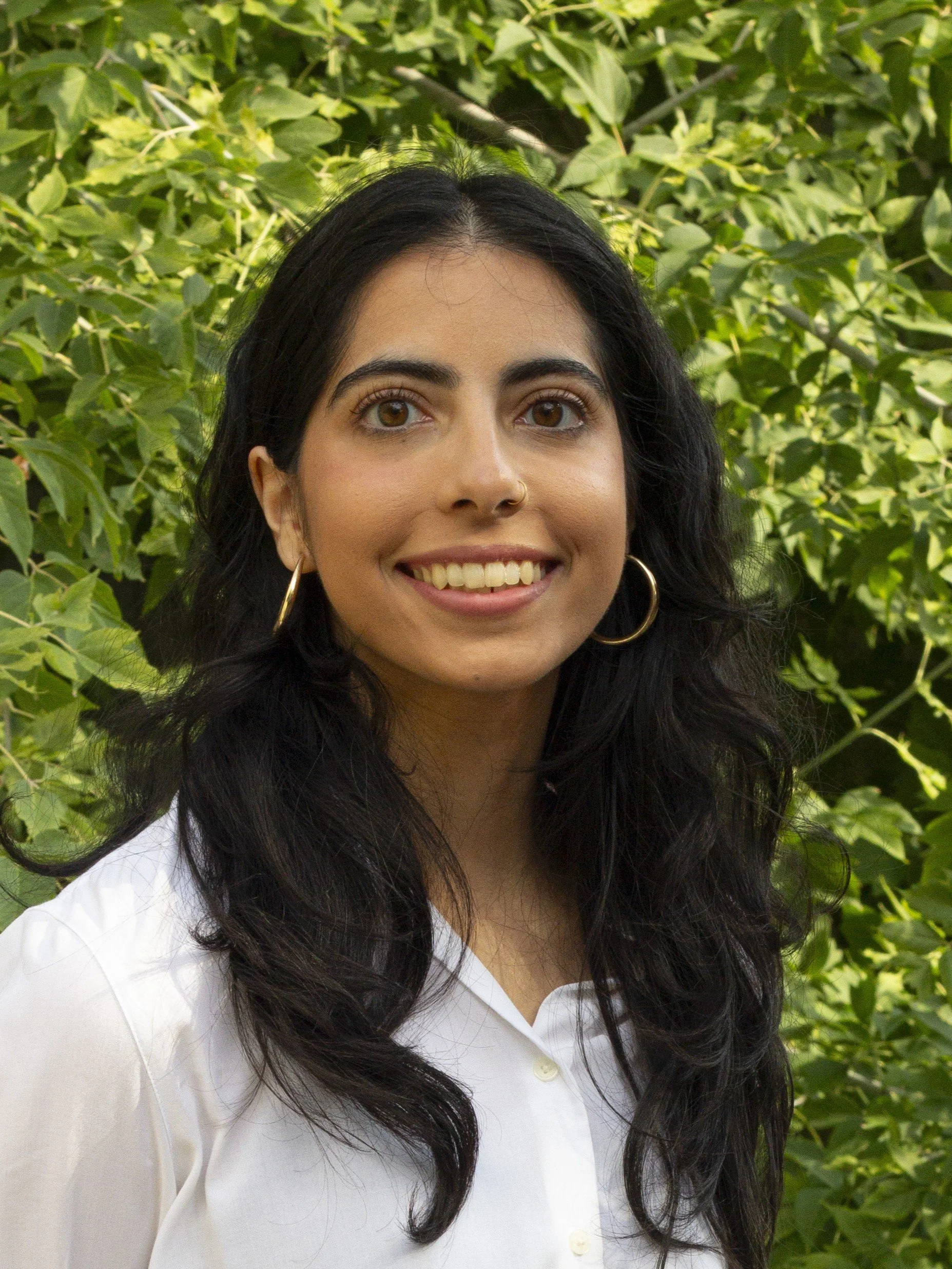
Aqsa Hussain.
AQSA HUSSAIN recently graduated with a bachelor's in history at the University of Saskatchewan, where she focused on social history and decolonization. She spent the summer and fall of 2024 as a researcher with the History department’s Co-Lab for Community Engaged Research, where she worked with the community of Île-à-la-Crosse to conduct oral histories and create a traditional land use map. She is a child of immigrants from Pakistan and grew up on Treaty 4 in Regina, Saskatchewan, and now resides in Saskatoon on Treaty 6 territory and the homeland of the Métis.
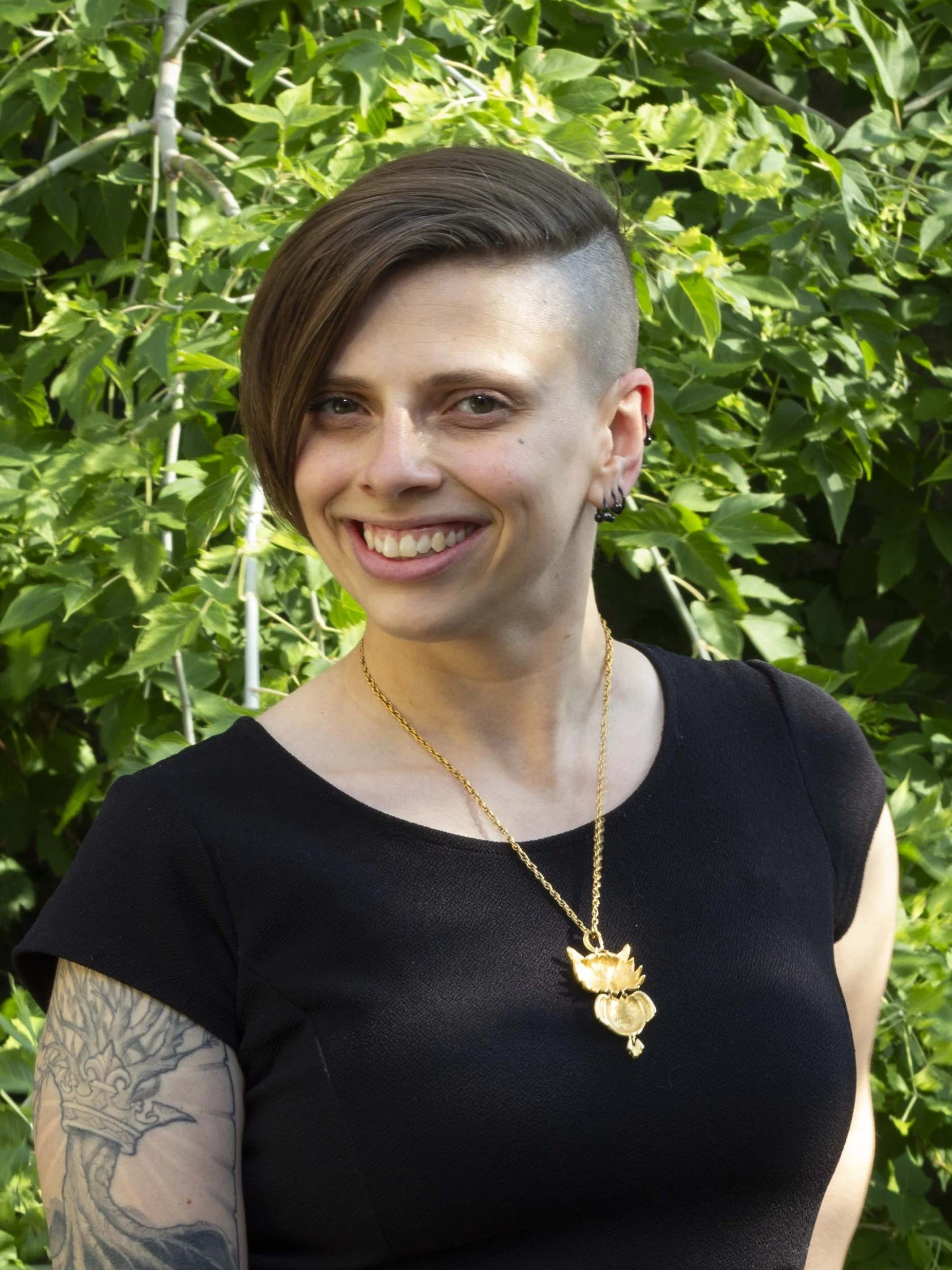
Jessica Jack.
JESSICA JACK is of white settler descent and was born and raised in Saskatchewan, spending most of her life in Saskatoon on Treaty 6 lands, the homeland of the Métis. Jessica has a master’s in medical anthropology, where she researched the impact of the COVID-19 pandemic on the reproductive decisions made by Saskatoon’s queer community. More recently, her work with the University of Saskatchewan’s History department’s Co-Lab for Community Engaged Research on the Sakitawak TLU 2024 inspired her to pursue a second master’s in Historical Geographic Information Systems (historical mapping). By combining her love of qualitative data like interviews and oral histories with her growing skills in visual analysis like mapping, Jessica hopes to support people in creating capacity to document and celebrate their cultures and their histories.
“people stories” shares articles from Folklore Magazine, a publication of the Saskatchewan History & Folklore Society. Click below to learn more about the Magazine and to find out how to get your story into the blog!