
Fashion History: An Interview with Peace Akintade
This interview was originally published in Folklore Summer 2025 and has been edited for clarity.
Kristin Enns-Kavanagh: Thanks so much for doing this with me. I’m very excited to learn a bit about you and art and fashion. This is for our fashion history series, which is talking about fashion in Saskatchewan and the relationships and connections that go around with garments and dress, and how important that is, and how maybe fashion sometimes doesn't get the credit it deserves as being an important social signifier and a place for social connections. That's a bit about what we're trying to do with the series. So, just to start with some general questions, can you give me your name, please, for the recording?
Peace Akintade: My name is Peace Akintade.
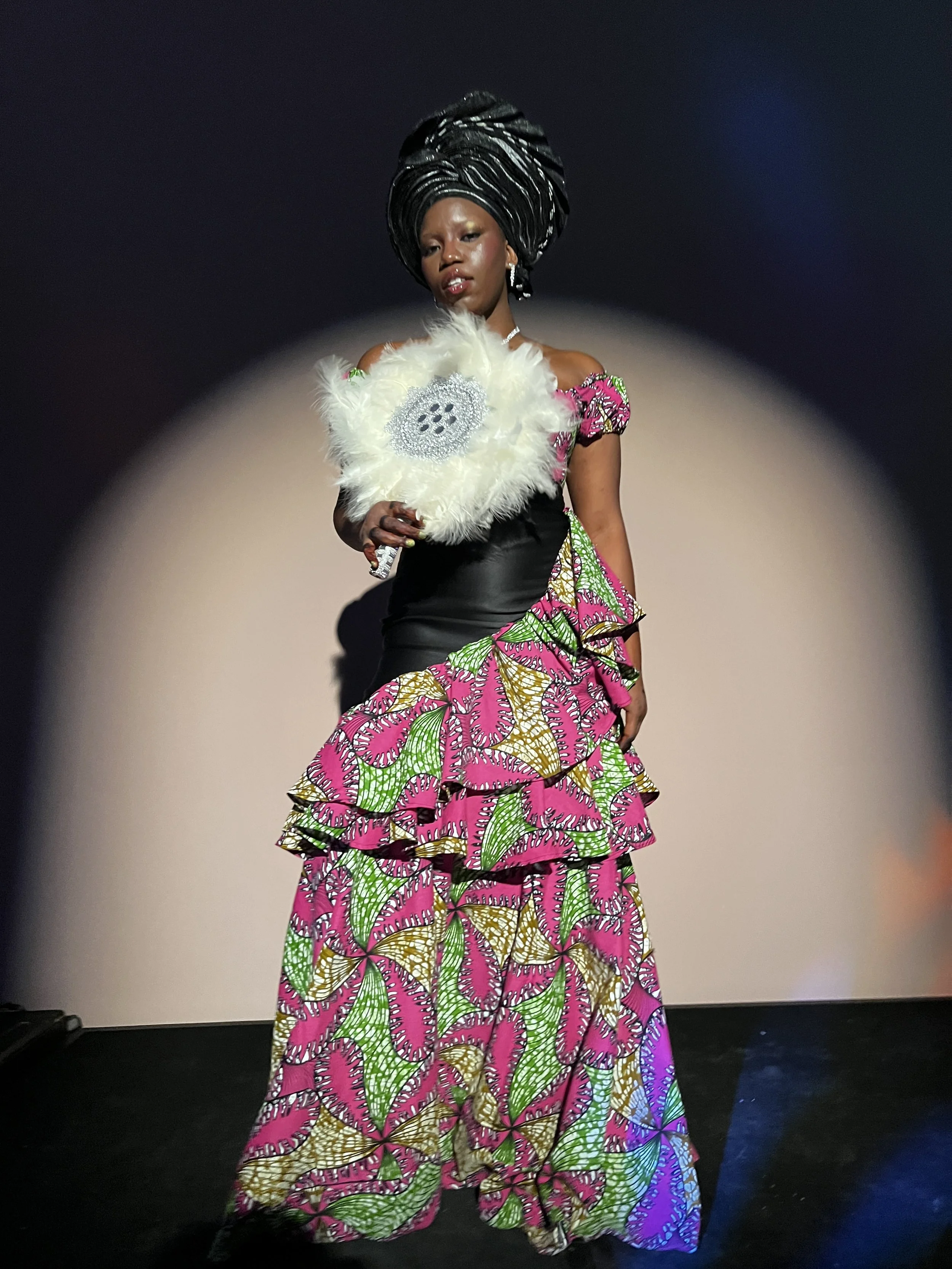
Peace Akintade-Oluwagbeye, courtesy of Aldeniel Española.
KEK: And where were you born?
PK: I was born in Nigeria. I'm part of the Yoruba tribe. But specifically, I was born in Lagos State.
KEK: And when were you born?
PA: 2002.
KEK: And your parents, what are their names?
PA: My mom is Titilayo Akintade-Oluwagbeye and my sister is Tobi Akintade, and then my brother is Ope Akintade.
KEK: Thank you. So, just some family background: Where did you grow up?
PA: I grew up in Nigeria, in Lagos State. From when I was born to around five, I lived in Nigeria. We lived in rural villages where they raised goats, just outside of Lagos. So we weren't really in the city, but we were just outside, on the farms. That was from birth to five years old, and then we moved to Kuwait from when I was about five to eight years old, just for work, and then we came back to Nigeria for three years, and then came to Canada. So, I've lived longer in Canada than I've lived in Nigeria altogether.
KEK: Thank you. Now I'll get into some of the questions about fashion. Where do you draw your inspiration for your clothing from? And has this changed over time?
PA: I definitely grow my inspiration from the traditions of Yoruba women back in Nigeria. A lot of my clothing, a lot of my fashion, has to do with representation in expression. I think it's important that, although I am a creative, I'm always going back to my roots. Everything always leads to African traditional practices. For example, African fabric and textiles are a very important part of my fashion. I don't really go outside without wearing at least one African textile. Either wrapped around me, or wrapped around my head, things like that. And that's reminding myself, again, of my roots. It helps that the textiles are so beautiful and colourful and really resonate with me and with how I view myself in the world. I view myself as an African woman. I want to represent that through my African textiles. So definitely, the inspiration comes from the Yoruba women in Nigeria.
KEK: And when did this start to become like a conscious practice for you to draw from your roots, to express yourself in dress?
PA: It's actually funny, because in Nigeria, when I was younger, I really, really didn't like wearing traditional clothes, and I’ll get into the mechanics of Nigerian clothing, but I really didn’t like wearing it. Because you know, everybody's wearing it. It's really itchy. And I am a kid that wants to be cool and wants to wear the cool outfit and the cool outfit in Nigeria is western clothing. So, whenever we were put into our Ankaras, I kept on saying, "No, let me wear this dress instead."
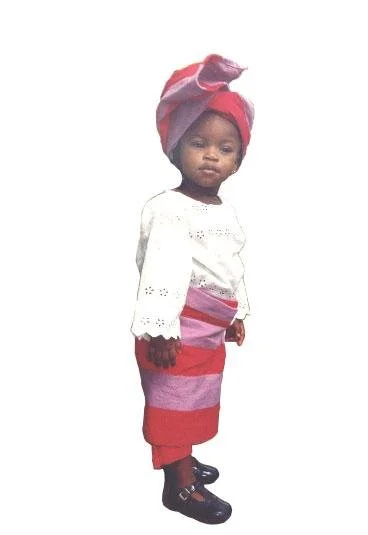
Peace Akintade.
But then I moved to Canada, and during 2012 to 2016, which is when I really started to be part of the Saskatoon community, and the isolation of immigrants here in Saskatoon made me miss home so much. And the only thing that I could do was wear the clothing. When I was around 19, I really started to have a consciousness for it, because instead of it being about missing home, it became a need. I needed people to know where I stand in things. Me working with African textiles and wearing African textiles and parading around in African textiles was a message, you know, to people, of saying, I don't really care about conforming anymore. I don't care about assimilating. I want to make a conscious effort to show that I am not moving towards that direction of assimilation.
So, I did the exhibition, “Do I Intimidate?” with the Art Gallery of Regina. This was my first real project, where I looked into African traditional practices, and the concept of intimidating others through what you wear. And that became my first real conscious effort.
KEK: Cool. I think you’ve maybe spoken to this a little bit but is there anything else you want to say about the connection between your fashion and your poetry and art and how you understand that relationship?
PA: I will say, “Do I Intimidate?” with the Art Gallery of Regina was a very important project for me, even though it's been years since I did it. It was the first project where I combined my fashion and my poetry, and also visual arts in one, and it was all connected to clothing. In Nigeria, we have this headdress. It's called Gele, and the Gele is an important symbol in Nigerian culture. In fact, they say that the bigger your Gele is, the more you are connected to your spirits. You know, to your spirits, to the world, to nature. That’s one part of it. Another part is the ceremony of wearing the Gele. You can't necessarily put it on by yourself. You always need someone to help you make the Gele, and so it was always an Elder, or your mother, or your sister- someone communal would put on the Gele for you. And that community is created just by a simple fabric, and you create this beautiful headdress, and it's such a huge symbol. If you Google search “Nigerian woman,” you will see a giant Gele. And that's who we are. That's our symbol.
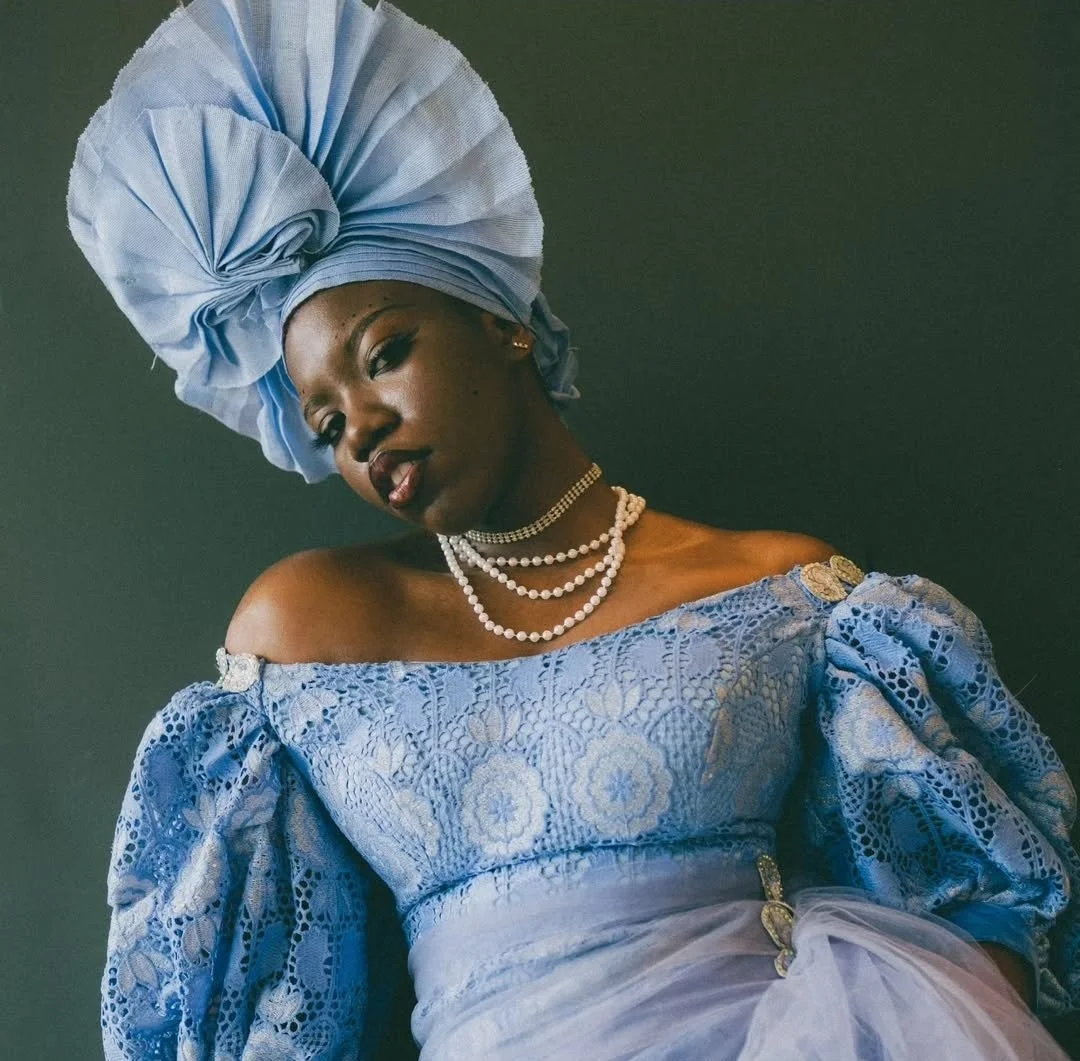
Peace Akintade-Oluwagbeye wearing a Gele, courtesy of Hannah Alex Photos.
The problem became -and this is what helped me start “Do I Intimidate?” -the problem became that when we came to Canada, we found that the Geles were actually getting less and less intricate and getting smaller and smaller. Instead of it being something that reaches almost to the sky and is large and big and colourful, it became a simple head wrap. I was curious to know why the time of large Geles was changing. So I asked around, and I did interviews with people, and a lot of them said that they didn't want to feel like a museum when they walked around Saskatoon. They didn't want to feel like a museum building. They could feel that people were intimidated by the Geles, so they started wearing them in more of a head wrap style, rather than in a traditional Gele.
The things that they told me, the things that they said, became a poem, and then that poem helped inspire the video and photography that became the exhibit. That's a connection through it. In the poem, I asked the question, “Do I intimidate,” as in, what exactly in my appearance dictates you to feel intimidated. Because for something seen as communal to now be changed and paraded as a mark of intimidation, is weird. It's wild to see that happening in real time.
So, I got one of the elders to come and do the Gele for me, and we had a video of me with the Gele being wrapped. And it was just beautiful.
KEK: I watched that video. There's parts where you have to hold the fabric while the other person wraps it, and everyone has a role, and you have to do it together. It's something that you can’t do by yourself. You’ve got to have that connection.
PA: Yes, exactly. It's really important. That project allowed me to now feel really connected to African textiles. So now, with African textiles, I actually did a little experiment that I didn't really video or photograph. It wasn't for an exhibition or anything. It was just for me, for my research.
Usually, whenever you're wearing African textiles, there's a bigger wrap, and then there's a smaller wrap. The small wrap is used to make a simple headdress for just going around, doing your errands. And then the larger wrap is wrapped around your waist, and you will wear something like a simple white t-shirt. That would be a normal, casual “going-out-to-do-errands” outfit. Because it was summer, I thought, well, there's no reason why I can't wear that. People are wearing shorts, people are wearing cargo pants, jorts -I can wear my large wrapper and headdress and just go around town.
It was good until I got to the grocery store. I was walking around doing my groceries, and my bag spilled, and potatoes spilled all over the place. Some people were helping me, but the grocery clerk came over to me and was quite aggressive about me spilling the potatoes. When I said, “oh, I am so sorry, I'm just going to carry everything” and I moved to the bagging area, bag that they gave me made it spill again (laughs). It was twice now that the potatoes spilled, and I was really stressed. And of course, anyone would be embarrassed.
Then the clerk asked me, “is this your first time in Canada?” and that rocked me. That rocked me a little bit, because at that point, I had been eleven years in Canada. They didn't even wait for an answer. They were just frustrated, and they said that not as a genuine question, but as a statement that ‘this is your first time in Canada.’ And that was - that was a lot. So, I went to the manager, and I told them what happened, and how incredibly rude and unneeded that stigma can be, especially when you're not helping someone, you know, you're just watching as they scramble to gather potatoes.
So, instead of making me want to not wear that outfit anymore, because I might be perceived as an immigrant who just came here and doesn't know anything, it made me want to wear it even more. Because that statement and deeming someone to have lesser knowledge than you because they are dressed in the traditional clothing of where they came from, that's the correlation between how you dress and how people perceive you as being of lesser knowledge. I found it fascinating, and instead of anger, I replaced it with a sense of pride, of needing to work with the African textiles so that whenever people wear them outside it's seen as artistry, rather than seeing it as ‘I'm an immigrant, you're a local.’ It should never be that. You should feel admiration for an African textile when you see it, rather than trying to express some prejudice. It really is that simple.
And so, I work with a lot of African textiles in my artwork. Whenever I go to workshops now, I always have African textiles spread around the table for people to sit on, for people to look at, you know, almost forcing them to come to the realization that they are working with an African person. Then, whenever they go outside and see that same kind of African textile, they will have a comfortability and a knowledge of it. Because, in fact, they are the ones with less knowledge, not us.
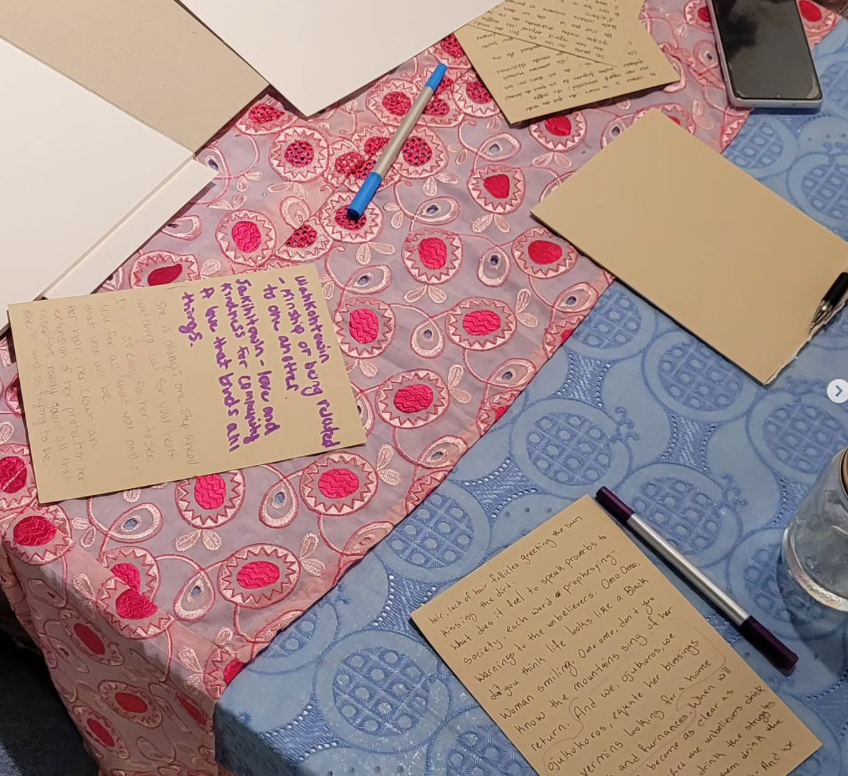
Every single artwork that I do now, I use African textiles, in collages, in my poetry. I have a series where I write people five-minute poems, and I sew in African textiles with it all as part of that knowledge. I wouldn't know, right now, if it's successful or not, unless I do it for at least four more years. But from what I am seeing, it's summertime now, so I'm going to wear my African attire and my African clothing, and we are just going to walk around like it's meant to be like that. That's my connection, at least, with African textiles.
KEK: Yes, and that, that helps people, like you said, gives them the sense that it's their job to elevate their own understanding and come to understand these textiles and clothing. So, speaking of textiles: When you were exhibiting at the Drop Spot Studio in Saskatoon, you were doing textile art, and talking about the African philosophy of textiles being to ‘think good thoughts’ when you're making things, because what you bring, I think the way you said it was, ‘the essence that you bring to the work will get absorbed in the fabric.’ Can you talk a bit more about that?
PA: Yes, so that was part of the research that I was doing, especially when it comes to African textiles and weaving. Weaving is such a huge part of it; the complexity of the design really is through the weaver. You have the weaver that has a machine that is weaving the clothing for the textiles, but then you now have the people that are actually wearing it, and in that group, there's also the storytellers. Storytellers are such a huge part of African philosophy and African story, African storytelling. The storytellers themselves are the ambassadors of African tradition. When you think of Africa, you think of oral storytelling. To be a storyteller is the highest title that you can give yourself or someone can give you. When storytellers wear these fabrics, being ambassadors, what they put into the world is what we see, and the clothing that they wear too is a representation of where they come from. That's the context of it all.
So African storytellers, now, have started to do a practice where, first of all, they communicate with the weaver for what kind of design that they want to wear for festivals, and then when they are practicing their stories, they cut the fabric and sew it themselves while practicing their stories out loud. It's almost like the stories are being embedded into the fabric as they're working. Then, when they put it on for the festivals, you can see all the hours of work in their clothing. With that knowledge that they have, that they have practiced with that fabric from when it was just a thread to now clothing, and then they speak -they have a feeling that comes over where you feel like it's not even you speaking anymore. It's every single time you practiced, speaking with you. So that became the urban legend, and it's something that people still do, and people don't realize that they do it in the western world too. Not necessarily making the clothes, but for example, some people put on their favorite shirt when they are going to a very stressful meeting. Or people have their favorite pajamas for watching their favorite show. All of that is you embedding memories into one particular item over and over and over again, and that item becomes embodied with your memories and with the feelings that you have. Whenever you wear it again, you're not just wearing clothing. You're wearing that memory.
And so the philosophy now became, for me -I took that knowledge and that whole thing that they do with African storytelling, and to bring it into my practice, I said okay, if every single part of African storytelling is all about doing memories, for example when they practice, and put that into the African textiles, why not continue that, but have those textiles for workshops where people are actively writing. They're not saying things out loud, but they're actively writing on top of the fabric. They're moving with the fabric. They're holding the fabric. When I put the fabric in a space, it's always the fabric that has followed me to about forty workshops now. It has every single person's stress. It has the poetry writing. It has them just laughing and talking. All of those memories are embodied in that fabric. When I put it up in a building it transforms the space. It doesn't just transform it with like, “oh, wow, there's colours,” but people walk in and they automatically feel connected.
When I did the Ori Ara Emi exhibition at the BAM Saskatoon, the exhibition really was just me sitting in one place. I wasn't doing anything. I wasn't making any statements about the fabrics, people were just walking in and the relief that I saw in their faces, just looking at the fabrics, you know, just staring at them. It's so simple, but I really, truly believe that it is that philosophy: When you embody good feelings towards a fabric or towards a space, people will connect to it. There's an energy about it that people will connect to it. That's why African storytellers are so enigmatic, you know, there's other things too, but they are very charismatic. Our eyes are our first senses and to see something immediately and be drawn to it is such a huge part of my art practice. That's the philosophy behind that. That's why I also feel people's energy gravitates towards those African textiles, because of all of the workshops that I do with them. The fabrics have followed me around, and in some ways, they've been embodied with the memories of other people and other poetry writing and workshops.
KEK: I certainly felt that way, walking in to see all the textiles. Do you have a particular item of dress that's important to you or that you're proud of? It could be something you're worn in the past, or something you're currently wearing?
PA: I love it when I'm able to wear the full Nigerian garment. That's the Aso-Oke, which is pretty much a shirt, a wrapper, and a harder woven shawl that you wear. And then you have the Gele, and then you have multiple jewelries that are, like, full on your neck. That's the full traditional Nigerian attire that you wear for special occasions. It's too heavy and too shiny (laughs) and too glamorous for me to wear as my everyday attire. I talk about, you know, that we should all wear what we need to, but there's practicality too. I cannot go driving in this outfit. It's the same thing as doing a dress for a gala. You know, you couldn't wear a dress for a gala every single place that you go. I never really get a chance to wear the full Aso-Oke attire, because we don't have enough special events happening in Saskatoon, but whenever I do get to wear it, I feel so transformed. One, it’s the pride that I see in other Nigerian’s faces when they see me in that attire. Every time I wear it, someone always thinks that I'm getting engaged, because it’s such a pompous, big statement when we get to wear it.
And I also feel pride in myself. I can see myself growing. I think whenever I wear the Aso-Oke, it's the first time that I ever actually see my inner child right in front of me. You know, there's some things that you do, activities that you do, that you can almost envision your childhood self also doing it. Whenever I wear the Aso-Oke and the Gele, and I look in the mirror, I can see my younger self, also wearing it and being happy about it. It always feels like a huge circle to be able to wear it.
Sometimes I will get pretty sad whenever I'm in special events, like Nigerian celebrations, and I or a few other Nigerian women are the only ones wearing it, and everybody else is wearing just Western dresses. I felt pretty sad about it when I was younger, because, again, it's that insecurity of when you're a teenager, you want to be part of what other people are doing. But now that I'm a young adult, no matter how many people are wearing western clothing, it doesn't matter if I'm the only one wearing the Aso-Oke, the full one. I still feel like my head is really tall, and I feel my most beautiful when I'm wearing the full Nigerian attire. I feel the most connected with it, with my people, and the itchiness or the sun and the heat doesn't matter. It doesn't matter because I feel every part of my body embodied, you know, with Nigerian…essence, I think that's the only word I can think of.
That is my favorite item to date to wear. I'm heading to Toronto at the end of July, and I'm bringing my Aso-Oke. I don't know where I'm going to wear it, but I know for sure that I want to wear it.
KEK: I’ll look forward to seeing the stories on Instagram of you wearing it. Is there anything else that we haven't talked about in terms of clothing?
PA: Yes, jewelry is also a really big part of Nigerian culture. We have a red necklace that we wear. Colors are also really important. Whenever there's a Nigerian event, a lot of people cut their outfits from the same yard. So, it would take maybe two yards of fabric to make two clothing items for a family. It's very important that family members are matching whenever they go to traditional Nigerian events. That's a way for you to see who's connected to who at events, by matching colors or matching designs. You can choose what kind of style you want your dress to be, but the colors and patterns are usually the same. That’s a pretty important part of the culture. I don't quite know the philosophy behind it yet. I'm pretty sure there's an urban legend to it somewhere. All of our philosophies are based on some kind of urban storytelling that I need to dig, dig, dig, to find. Usually, it has to do with a tortoise or something, and maybe they saw something in nature and wanted to mimic it. That's a true statement for the origins of Nigerian traditions -seeing something in nature and mimicking it. When I do find the reason why we match clothes, I'll let you know. But now, it’s cutting from the same yard and having the same colors and patterns. Other than that, I think that's everything right now that I can speak on.
KEK: I think the gown that's in your profile pic, the blue one, I feel like there was an Instagram story where I think your mom and sister had matching outfits. Is that an example?
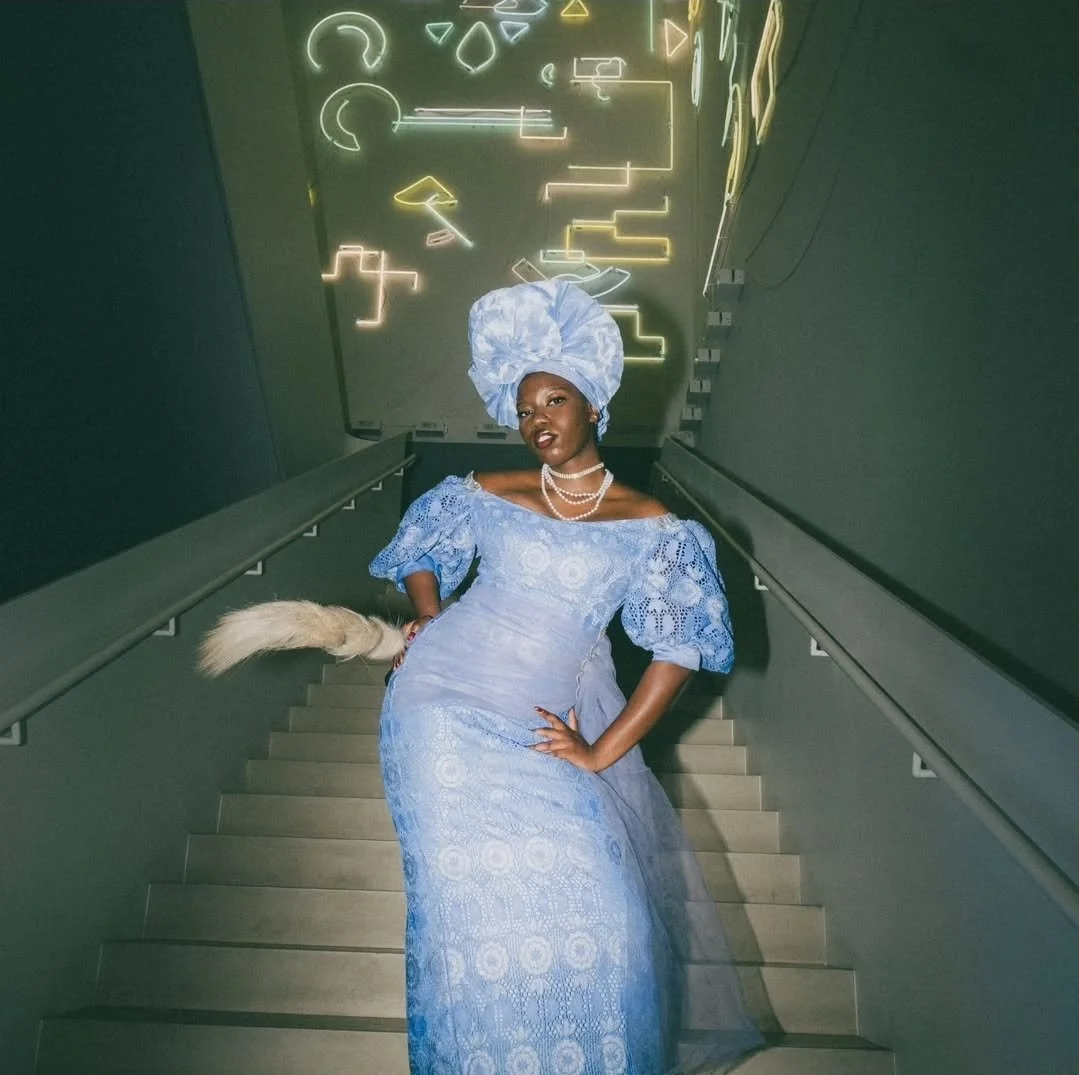
Peace Akintade, courtesy ofHannah Alex Photos.
PA: Yes, they had all that matching fabric, but it's different kind of cuts. The first time I wore that dress - we get all our clothing done in Nigeria, actually, so we send our measurements to the tailor in Nigeria, and then the tailor brings it over to Canada. And when I sent my measurements, it was before I started bodybuilding. By the time the dress came back, it took me, my sister, my brother and my mom to get me into the outfit because my shoulders were so big now that there was no way for it to fit (laughs). But, we got it to fit. So yeah, sometimes it can be tricky getting new outfits created, because they have to go to Nigeria, and then you have to wait five months for them to come back. A lot of our clothes are tailored. Rarely do we buy just ready-made stuff. You know, usually you have a tailor that makes it for you or designs and makes it for you.
KEK: Did you see the fabric before it was made up? Like, did you choose the fabric ahead of time and send it, or did you look at it online, or?
PA: Yes, the tailor in Nigeria will do a video call with the fabrics, and then my mom would be yelling at the phone, pretty loudly, in Yoruba, trying to get the price down, and they'll usually have a yelling match, but it's never like, mean, you know, the yelling is never mean. It's always like, why are you trying to overcharge me? And then the tailor is like, I don't know, you're in Canada. That's the argument for everything whenever we have to make new clothes, they will overcharge us, and then they'll be like, you're in Canada, we're in Nigeria. What are you going to do? So that's been a little hard. The mechanics of getting new clothing is quite tricky when you're not in Nigeria itself. But we do have tailors here in Saskatoon, and we also have a store that does African prints, so you can get ready-made textiles already. You can just like, pick the yard, and it’s very limited colors. It's not as much as you would find in Nigeria, but it's at least enough for you to get a few clothes or Ankaras, which are more casual Nigerian clothing.
KEK: Nice, awesome. I think that was all the questions I had, and I think that all our time. Thank you so much for doing this.
PEACE AKINTADE-OLUWAGBEYE (she/her) is an African-Canadian Interdisciplinary Poet, Public Speaker, Chorus-Poem Playwright, and Thespian residing in Saskatoon, Saskatchewan. Organically from Yorubaland, Nigeria, Peace explores the intersectionality of the artist community from an explorer's perspective, dipping her honey-stained fingers into poetry, dance, performance art, critical research, and the theatre world.
“people stories” shares articles from Folklore Magazine, a publication of the Saskatchewan History & Folklore Society. Click below to learn more about the Magazine and to find out how to get your story into the blog!